Cooking Technique
Cooking dried beans properly
Dried legumes are the cheapest good food available and most people cook them badly, which is why they think they prefer the tin.
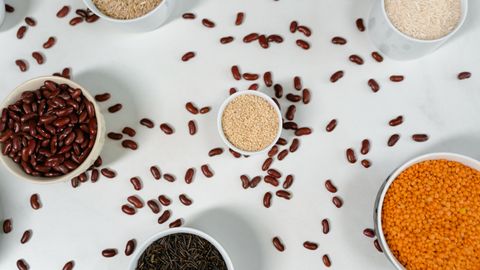
A pot of well-cooked beans is one of the best things you can make and it costs almost nothing. Badly cooked beans are chalky, bland and split, which is what puts people off.
The difference is a small number of things.
Soaking
Soaking reduces cooking time, improves texture consistency and reduces oligosaccharides, which are the compounds responsible for the well-known effect.
Overnight in plenty of water, or a quick soak — boil for a couple of minutes, cover, stand for an hour.
Discard the soaking water. This removes some of the oligosaccharides and it is the main reason to soak beyond time saving.
Lentils and split peas do not need soaking.
You can cook unsoaked beans. It takes longer and the texture is less even, and it works.
Salt in the water
The most persistent kitchen myth in this area is that salting beans early makes them tough.
It does not. Testing has consistently found that salted beans cook to a better texture, with skins that are more tender and less prone to bursting.
Salt the soaking water and the cooking water. Generously — think of it like pasta water.
The beans season from the inside, which no amount of salt added afterwards achieves.
What actually makes beans tough
Acid. Tomatoes, vinegar and lemon added early genuinely slow softening. Add acidic ingredients after the beans are tender.
This is why beans in a tomato sauce should be cooked first and combined afterwards.
Age. Old dried beans take much longer and sometimes never soften properly. There is no way to tell by looking, which is why beans from a shop with high turnover are worth seeking out.
Hard water, in some cases. A pinch of bicarbonate of soda helps and too much produces slippery beans and destroys some nutrients.
The cooking
Cover generously with water — several centimetres above the beans, since they absorb a great deal.
Bring to a boil, then reduce to a bare simmer. A rolling boil breaks the skins and produces a pot of mush and loose skins.
You want the surface barely moving.
Skim the foam in the first few minutes if you like; it is not necessary.
Cook until genuinely tender. Not al dente — beans are unpleasant undercooked, and the difference between nearly done and properly done is substantial.
Test several, since they cook unevenly. A properly cooked bean is completely creamy inside with no chalkiness.
Aromatics
This is where a pot of beans becomes something worth eating.
Into the cooking water: an onion halved, a few garlic cloves, a bay leaf, a strip of dried chilli, a piece of kombu, a sprig of herbs, a knob of ginger, a whole dried mushroom.
Remove the aromatics before serving, or not.
A glug of olive oil in the pot improves texture and flavour considerably.
The liquid
The cooking liquid is the best part and people throw it away.
It is starchy, savoury and full of flavour. Use it as the base for a soup, to loosen the beans when reheating, to cook rice in, or as a sauce with the beans themselves.
Do not drain a pot of beans down the sink.
Quantities and storage
Dried beans roughly double to triple in weight when cooked. A hundred grams dry gives a generous portion or two.
Cook a large batch. They keep three or four days in the fridge in their liquid, and they freeze extremely well — freeze in portions with enough liquid to cover.
Cooking two hundred and fifty grams of dried beans takes the same attention as cooking a hundred, and it removes the main obstacle to eating them regularly.
Pressure cookers
Genuinely transformative for beans. Cooking times drop to a fraction, unsoaked beans become practical, and the texture is good.
If you eat legumes regularly, this is the one piece of equipment worth buying.
The digestion question
Beans cause wind because they contain oligosaccharides that human enzymes cannot break down and gut bacteria ferment.
What helps:
Soaking and discarding the water.
Thorough cooking.
Adding a piece of kombu to the pot, which is traditional in Japanese cooking and which some evidence suggests helps.
Spices — asafoetida, cumin, ginger, epazote — used traditionally for exactly this purpose across several cuisines.
And, most effectively, eating them regularly. Gut bacteria adapt over weeks, and people who eat legumes daily report far less trouble than occasional eaters.
The advice to avoid beans because of the effect is backwards. Eat them more often.
Tinned beans
Entirely fine. Convenient, nutritionally comparable, and more expensive per portion.
Rinse them if you want to reduce sodium, and know that the liquid in the tin is useful in the same way as cooking liquid.
Use tins on weeknights and cook a pot at the weekend. Both belong in a kitchen.
Also by Owen Brannagh
- Eating plant-based where the shops are limitedTransition & Family
- Dinner formulas that work every timeMeal Building
- Cooking with almost no equipmentCooking Technique
- Iron-rich meals: putting the principles togetherMicronutrients