Cooking Technique
Roasting vegetables so they are worth eating
Roasting is the technique that converts vegetable sceptics, and most people do three things wrong.
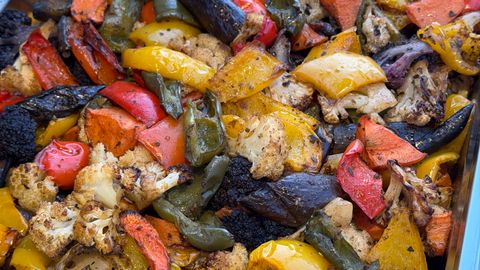
Roasting turns vegetables sweet, browned and crisp at the edges. It is the technique that makes people who dislike vegetables eat them.
Three errors account for most failures.
Error one: the oven is not hot enough
Roasting requires high heat. Somewhere around 200 to 230 degrees Celsius, or the equivalent in a fan oven, which runs hotter.
Lower temperatures dry vegetables out slowly without browning them, producing something shrivelled and pale.
The browning is the point. It is the Maillard reaction and caramelisation, and it is where the flavour comes from.
Preheat properly, and preheat the tray if you want a good crust on the underside.
Error two: the tray is crowded
The single most common mistake.
Vegetables piled up release moisture, and the moisture cannot escape, so they steam. Steamed vegetables in an oven are grey and soft.
Everything should be in a single layer with space around each piece.
Use two trays. This feels excessive and it is the difference between roasted and stewed.
Error three: not enough oil or salt
Oil conducts heat to the surface and produces the crisp exterior. Too little and the vegetables dry rather than brown.
Be more generous than feels right — enough to coat everything, tossed properly so every surface is covered.
Salt before roasting, not after. It draws out a little moisture initially and then seasons throughout.
The technique
Cut into similar sizes so everything cooks evenly. Larger pieces for things that cook fast, smaller for things that do not, if you are mixing.
Dry the vegetables. Wet vegetables steam.
Toss thoroughly in oil and salt, in a bowl rather than on the tray, so the coating is even.
Cut sides down where there is a cut side, since that is where the browning happens.
Leave them alone for the first half. Turning too early prevents the crust forming.
Turn once, roast until properly browned. Most people take them out too early — the difference between pale and properly caramelised is ten more minutes.
Timings, roughly
Fast, twenty to twenty-five minutes: broccoli and cauliflower florets, asparagus, courgette, mushrooms, cherry tomatoes.
Medium, thirty to forty minutes: peppers, onions, sprouts halved, aubergine, fennel.
Slow, forty to sixty minutes: potatoes, squash, carrots, parsnips, beetroot, whole garlic.
Do not put fast and slow items on the same tray at the same time. Either use two trays or add the fast ones partway through.
The vegetables that transform
Brussels sprouts. Halved, cut side down, roasted until the outer leaves are almost black. Entirely unlike the boiled version and the reason many people who hated them as children now eat them.
Cauliflower. Broken into florets, roasted until deeply browned. Whole roasted cauliflower is also excellent and takes about an hour.
Broccoli, including the stem, which is the best part — peel it and cut it into batons.
Carrots, which become intensely sweet.
Cabbage, cut into thick wedges and roasted cut side down. Under-used and excellent.
Squash, which barely needs anything.
Chickpeas, drained and dried thoroughly, roasted until crisp. A topping rather than a vegetable and it belongs in this list.
Finishing
The step that turns roasted vegetables into a dish.
Acid immediately out of the oven: lemon juice, vinegar, or a squeeze of orange.
Something fresh: herbs, spring onion, chopped chilli.
Something with texture: toasted nuts, seeds, breadcrumbs.
A sauce: tahini, yoghurt alternative, herb sauce.
All four together, on any roasted vegetable, produces something considerably better than the sum of it.
Spices
Whole spices toasted alongside the vegetables. Cumin seeds, coriander seeds, fennel seeds, mustard seeds.
Ground spices burn at high heat, so add them partway through or mix them into the oil where they are protected.
Smoked paprika, cumin, za'atar, garam masala and chilli flakes all work with almost any vegetable.
The practical use
Roast a large tray at the weekend. It keeps four or five days.
Then: in a grain bowl, blended into soup, in a wrap, on toast with beans, folded into pasta, or eaten cold with dressing.
This is the single most useful component to have in the fridge.
Also by Owen Brannagh
- Eating plant-based where the shops are limitedTransition & Family
- Dinner formulas that work every timeMeal Building
- Cooking with almost no equipmentCooking Technique
- Iron-rich meals: putting the principles togetherMicronutrients