Cooking Technique
What The Convection Setting Actually Changes
A convection fan moves air across food rather than raising oven temperature, which speeds heat transfer, dries surfaces faster and changes how roasted vegetables finish.
Ovens sold in the United States increasingly include a convection setting, and the button is often used without a clear sense of what it does. It moves air, and everything else follows.
Still air is an insulator
In a conventional oven, food warms a thin layer of air around itself. That warmed layer lingers and slows further heat transfer from the hotter air beyond it.
A fan strips that boundary layer away continuously, replacing it with air at the full oven temperature. The food therefore receives heat faster at the same nominal setting.
This is why convection recipes commonly call for a lower temperature or a shorter time. The oven is not hotter; heat is simply arriving more efficiently.
Moving air dries surfaces
Air movement also carries away water vapor evaporating from the food. A drier surface reaches higher temperatures than a wet one, because evaporation no longer holds it near boiling.
Browning reactions require those higher surface temperatures. Roasted vegetables develop color and crisp edges sooner in a fan oven for exactly this reason.
The same mechanism works against foods that should stay moist. Delicate items and anything relying on a wet surface can dry out before the interior finishes.
Where it helps a plant-centered kitchen
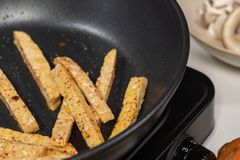
Sheet pan roasting benefits most, because the goal is surface transformation across a large area. Cauliflower, chickpeas, root vegetables and tofu all crisp more evenly with air movement.
Multi-rack cooking is the other clear gain. Still ovens have pronounced hot and cool zones, and circulating air narrows the difference between the top and bottom shelves.
Dehydrating at low temperatures, for fruit slices or crackers, also depends on moving air. Without it, the humid layer around the food stalls drying entirely.
Where it hurts
Batters and doughs that need time to set can be pushed around by a strong fan, setting lopsided. Many ovens allow the fan to be switched off for this reason.
Custard-style dishes, including many silken tofu preparations, prefer gentle even heat without surface drying. A conventional setting, sometimes with a water bath, suits them better.
Covered braises are indifferent. Once a lid is on, the air outside it has little influence on what happens inside the pot.
True convection versus a fan
Some ovens simply add a fan to the existing elements. Others add a third heating element around the fan itself, which is often labeled true or European convection.
The difference is how uniform the circulating air's temperature is before it reaches the food. Both approaches speed cooking; the third element mainly improves evenness.
Either way, the practical adjustment is the same. Check earlier than the recipe says, and judge doneness by the food rather than by the clock.
Also by Owen Brannagh
- Eating plant-based where the shops are limitedTransition & Family
- Dinner formulas that work every timeMeal Building
- Cooking with almost no equipmentCooking Technique
- Iron-rich meals: putting the principles togetherMicronutrients