Cooking Technique
Cut Size Decides Cooking Time
Heat travels inward from a surface, so the thickness of a piece governs how long it takes to cook, and uniform cuts matter more than exact recipe timings.
Recipe times assume a cut size the recipe rarely specifies precisely. Since heat enters only through the surface, the dimension from surface to center controls everything.
Distance, not weight, sets the time
Heat conducts inward at a rate set by the food's composition and the temperature difference. Doubling the thickness of a piece more than doubles the time to heat its center.
Weight is a poor proxy. A pound of thinly sliced sweet potato cooks in a fraction of the time a single pound-sized chunk needs.
This is why cubing a squash speeds roasting dramatically while simply cutting it in half barely does. The relevant distance changed only in the first case.
Surface area drives browning too
Smaller pieces present more surface relative to their volume, so more of the food can brown. A tray of small cubes finishes with proportionally more caramelized exterior.
Larger pieces trade that for a moist, distinctly textured interior. Neither is better; they are different results from the same vegetable and oven.
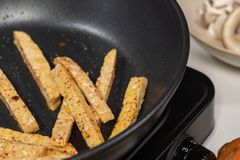
Cutting shape matters alongside size. Flat planks maximize contact with a hot sheet pan, while irregular chunks make contact at only a few points.
Uniformity beats precision
A tray of mixed sizes finishes at mixed times, leaving small pieces scorched while large ones remain firm. The tray is judged by its worst pieces.
Consistent cuts remove that problem without requiring any particular size. Anything cut evenly can be timed as a single item.
This is the practical reason knife skills matter in home cooking. The benefit is uniformity, not speed or appearance.
Density complicates matters
Dense, low-moisture vegetables such as carrots and beets conduct heat more slowly than airy ones such as zucchini or mushrooms. Equal cubes still finish at different times.
The usual adjustment is to cut denser vegetables smaller, so that different foods can share a pan. A mixed roast is really an exercise in equalizing cooking times.
Alternatively, denser items go into the oven first and lighter ones join partway through. Staggering achieves the same equalization through timing instead of geometry.
What this means for legumes and grains
Whole grains and dried beans cannot be cut, so their cooking times are fixed by their natural size and skin. Soaking substitutes by shortening the hydration stage.
Split legumes, such as red lentils and split peas, are effectively pre-cut. Their halved geometry and missing skin explain why they collapse in twenty minutes.
Cracked or rolled grains follow the same logic. Steel-cut and rolled oats are the same grain processed to different thicknesses, which is the whole of the cooking-time difference.
Also by Owen Brannagh
- Eating plant-based where the shops are limitedTransition & Family
- Dinner formulas that work every timeMeal Building
- Cooking with almost no equipmentCooking Technique
- Iron-rich meals: putting the principles togetherMicronutrients