Protein & Amino Acids
Why Grain And Legume Proteins Differ
Grains and legumes store protein in different molecular families with different amino acid profiles, which is a consequence of how each seed germinates.
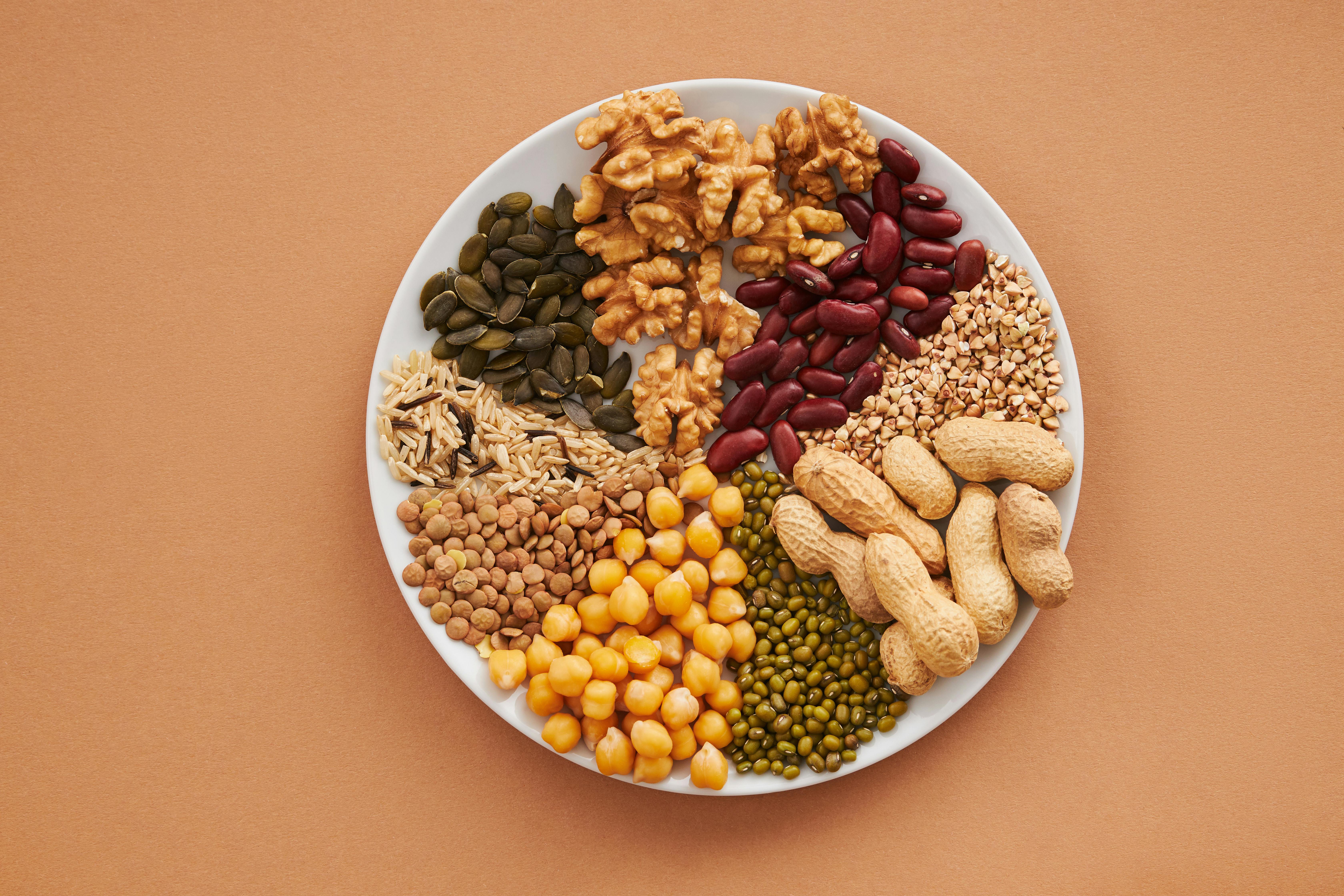
The complementarity of grains and legumes is usually presented as a happy coincidence. It is not coincidental, and the reason lies in the biology of two different kinds of seed.
Storage protein as a nitrogen bank
A seed must carry enough nitrogen to build the first structures of a seedling before roots can draw any from soil.
It stores that nitrogen as protein packed into dedicated bodies within the seed's tissue. These storage proteins have no enzymatic job; they exist purely as reserves.
Because their function is storage rather than activity, their amino acid composition is shaped by what is efficient to pack and to break down, not by any nutritional balance.
The prolamins of cereals
Cereal seeds rely heavily on prolamins, a family named for their high proline and glutamine content. Wheat gliadin, maize zein and barley hordein all belong to it.
Prolamins are notably low in lysine and in tryptophan. A grain protein therefore falls short of human requirements in those two before any other consideration.
Their high proline content also affects texture. Gluten's elasticity is a direct consequence of the prolamin structure, which is why wheat behaves in dough as no legume flour does.
The globulins of legumes
Legume seeds store protein mainly as globulins, which are richer in lysine and generally better matched to human needs in that respect.
They are comparatively low in methionine and cysteine, the sulphur-containing amino acids, which cereals supply more adequately.
Legumes also fix nitrogen through root bacteria, so they operate under less nitrogen constraint than cereals and can afford protein-rich seeds. Their higher protein content follows from that relationship.
Why the profiles fit together
The shortfall of one family sits where the other is comparatively strong, so a mixed intake produces an amino acid pattern closer to requirements than either alone.
This is why agricultural systems that paired a cereal with a legume, and cuisines built on those pairings, persisted across very different regions.
The pairing does not need to occur within a single meal. The circulating amino acid pool buffers supply over hours, so consistency across the day is what counts.
What this changes in practice
Someone eating legumes daily alongside grains has already solved the amino acid problem without any calculation.
The pattern that fails is a cereal-dominated diet with legumes appearing occasionally, which is a real risk in restricted or very repetitive eating.
Soy sits somewhat apart, being well supplied in both directions, which is why it is treated separately in most discussions of plant protein quality.
Also by Dr. Farah Siddiqui
- Sustaining it for decadesTransition & Family
- Reintroducing foods, if you decide toTransition & Family
- Young athletes on plant-based dietsSport & Performance
- Protein requirements across a lifetimeProtein & Amino Acids